- August 1, 2026
biomass pellet industry has quietly become one of the most important stories in global renewable energy. What was once a niche way to dispose of farm and forestry waste is now a fast-scaling fuel category adopted by power plants, industrial boilers, and export markets across the world. Companies like Yulong-Gattuwala are at the center of this shift, turning agricultural residue into a dependable, clean-burning fuel source for India and beyond.
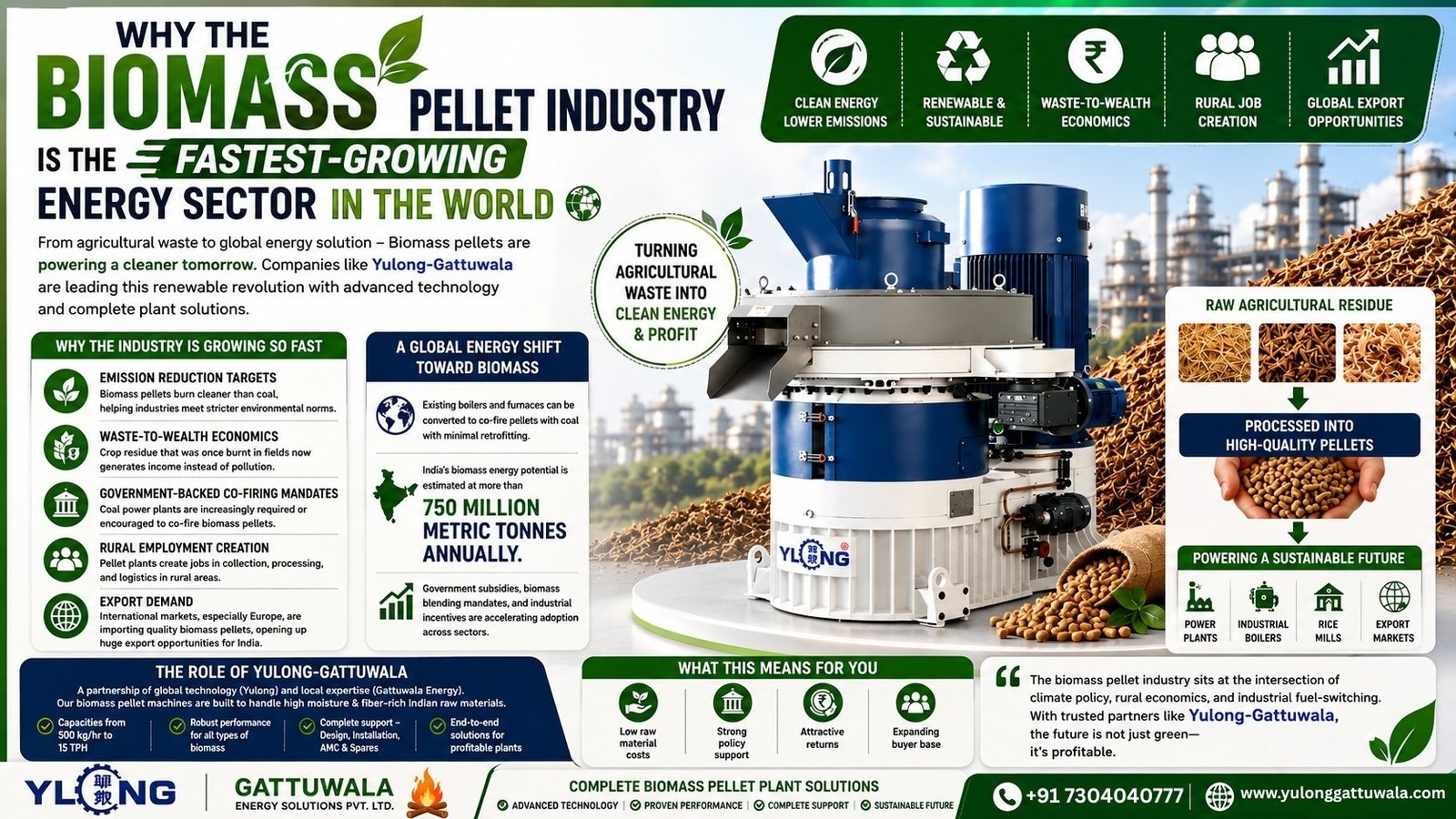
emerged as one of the easiest transitions available — existing boilers and furnaces can often be converted to co-fire pellets alongside coal, with minimal retrofitting. This is a major reason the biomass pellet industry is expanding so quickly: it doesn’t require industries to rebuild infrastructure from scratch, only to change the fuel feeding it.
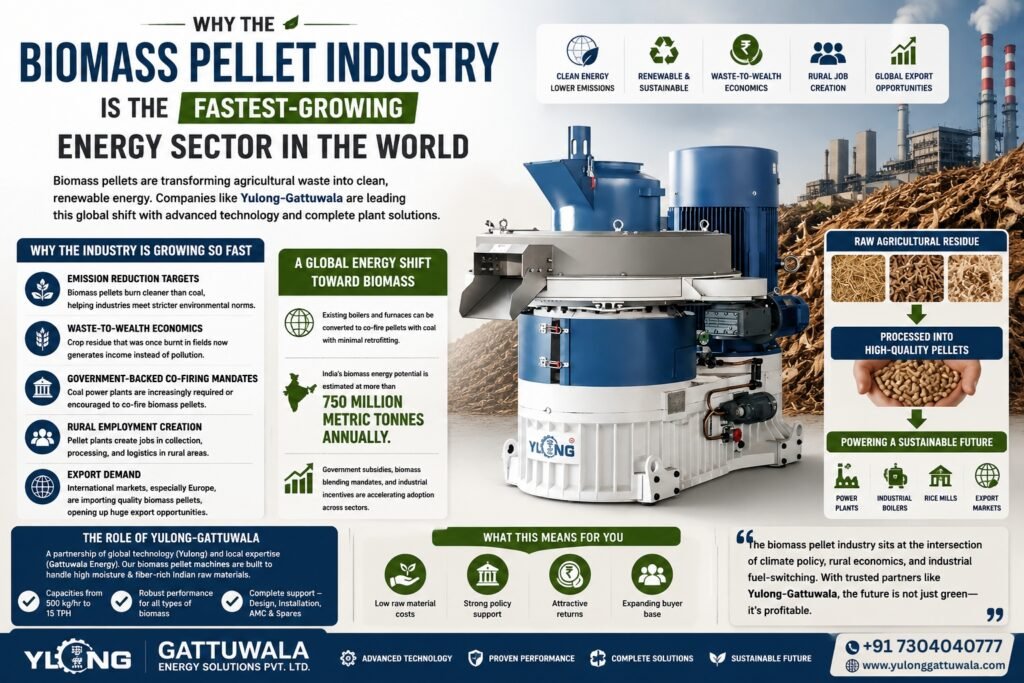
In India specifically, the scale of opportunity is enormous. The country’s biomass energy potential is estimated at more than 750 million metric tonnes annually, and government initiatives including renewable energy subsidies, biomass blending mandates, and industrial incentives are accelerating adoption. This has driven a sharp increase in the number of biomass pellet manufacturers across the country.
Several forces are converging to push the biomass pellet industry forward:
• Emission reduction targets: Biomass pellets burn significantly cleaner than coal, helping industries meet stricter environmental norms.
• Waste-to-wealth economics: Crop residue like paddy straw, cotton stalk, and bagasse — traditionally burnt in open fields — now generates income instead of pollution.
• Government-backed co-firing mandates: Coal power plants are increasingly required or encouraged to co-fire biomass pellets, creating steady institutional demand.
• Rural employment creation: Pellet plants create jobs in collection, processing, and logistics in areas that previously had few industrial opportunities.
• Export demand: International markets, especially Europe, are importing biomass pellets that meet quality standards like ENplus, adding a global sales channel for Indian producers.
The Role of Yulong-Gattuwala in This Growth
Within this expanding industry, Yulong-Gattuwala has positioned itself as a key enabler on the ground in India. The company is a partnership between Yulong, a globally recognized Chinese pellet machine manufacturer with two decades of engineering experience, and Gattuwala Energy, an Indian renewable energy company focused on pellet plant solutions.
This collaboration matters because it combines two things India’s biomass sector needs simultaneously: proven international pelletizing technology, and local expertise in adapting that technology to Indian conditions. <cite index=”2-1″>Yulong-Gattuwala’s biomass pellet machines are designed to handle raw materials with high moisture and fiber content, which suits India’s agricultural residues.</cite> Machines in this range span capacities <cite index=”2-1″>from 500 kg per hour up to 15 tonnes per hour</cite>, serving everyone from small-scale farmer-entrepreneurs to large industrial pellet exporters.
Yulong-Gattuwala’s involvement goes beyond just selling machinery. The company supports project design, layout planning, installation, trial production, and ongoing AMC and spares support — the kind of end-to-end assistance that determines whether a pellet plant actually runs profitably after the machine is delivered. This full-cycle support is part of why farmers and cooperatives adopting Yulong-Gattuwala systems have been able to turn agricultural waste into a recurring income stream, supplying pellets to brick kilns, textile boilers, rice mills, and power generation companies pursuing biomass co-firing.
What This Means for Entrepreneurs and Industries
For anyone evaluating entry into the biomass pellet industry, the combination of strong policy support, growing institutional demand, and accessible turnkey technology from suppliers like Yulong-Gattuwala makes this one of the more favorable moments to invest. Raw material costs are low, government incentives reduce upfront capital burden, and the buyer base — from coal power plants to export markets — continues to expand.
The biomass pellet industry isn’t growing by accident. It sits at the intersection of climate policy, rural economics, and industrial fuel-switching, and manufacturers like Yulong-Gattuwala are translating that opportunity into working plants on the ground across India. As co-firing mandates tighten and more industries look to cut coal dependency, demand for reliable pelletizing technology is only expected to increase.